
Virginia Corrections Release Destinations
Virginia Department of Corrections institutions hold state-responsible prisoners. They are not Bedford County jails. A person convicted in Bedford can move from Bedford Adult Detention Center into a VADOC institution chosen through the statewide classification process. That transfer ends the BRRJA jail episode but starts or continues state imprisonment. It is not a return to the community.
An actual VADOC release can lead to parole, probation, another form of community supervision, or discharge. Parole is conditional release from prison for an eligible person. Probation is court-ordered supervision that may follow incarceration. Discharge means the identified state custody or supervision term has ended. A transfer, detainer pickup, or unresolved sentence can instead keep the person in government custody after departure from one institution.
Search Virginia Corrections Release Status
The VADOC Inmate and Supervisee Locator is the correct public search route. It covers people in VADOC institutions, probationers and parolees supervised by district offices, institutional-hospital placements, some people housed in local or regional jails under VADOC authority, and Community Corrections Alternative Program participants. It does not cover every person ever booked at BADC.
| Search field | How to use it |
|---|---|
| DOC ID | Enter the seven-digit identifier for the most precise match. |
| First name | Use at least the first three letters when searching by name. |
| Last name | Enter the full last name required by the locator. |
| Location | Separate a prison institution from a community-supervision district. |
| Race, gender, age range | Use optional filters only to distinguish people with similar names. |
- Use the seven-digit DOC ID when known. It is the most precise public search key.
- For a name search, enter at least the first three letters of the first name and the full last name.
- Accept the locator disclaimer and use location, race, gender, or age range only to resolve identity.
- Save the DOC ID, status or location, displayed date fields, and access date.
- Read an institution result differently from a probation or parole district assignment.
A prison location means the person remains confined. A District 20 Bedford or other district result supports community supervision rather than prison confinement. A completed release date is retrospective evidence. A future release date is prospective and can change. VADOC says the locator updates daily, may contain inaccurate or outdated information, and is not promised as a permanent archive of every fully discharged person.
The official statewide locator screen provides the matching search fields for a Bedford County state-custody case.
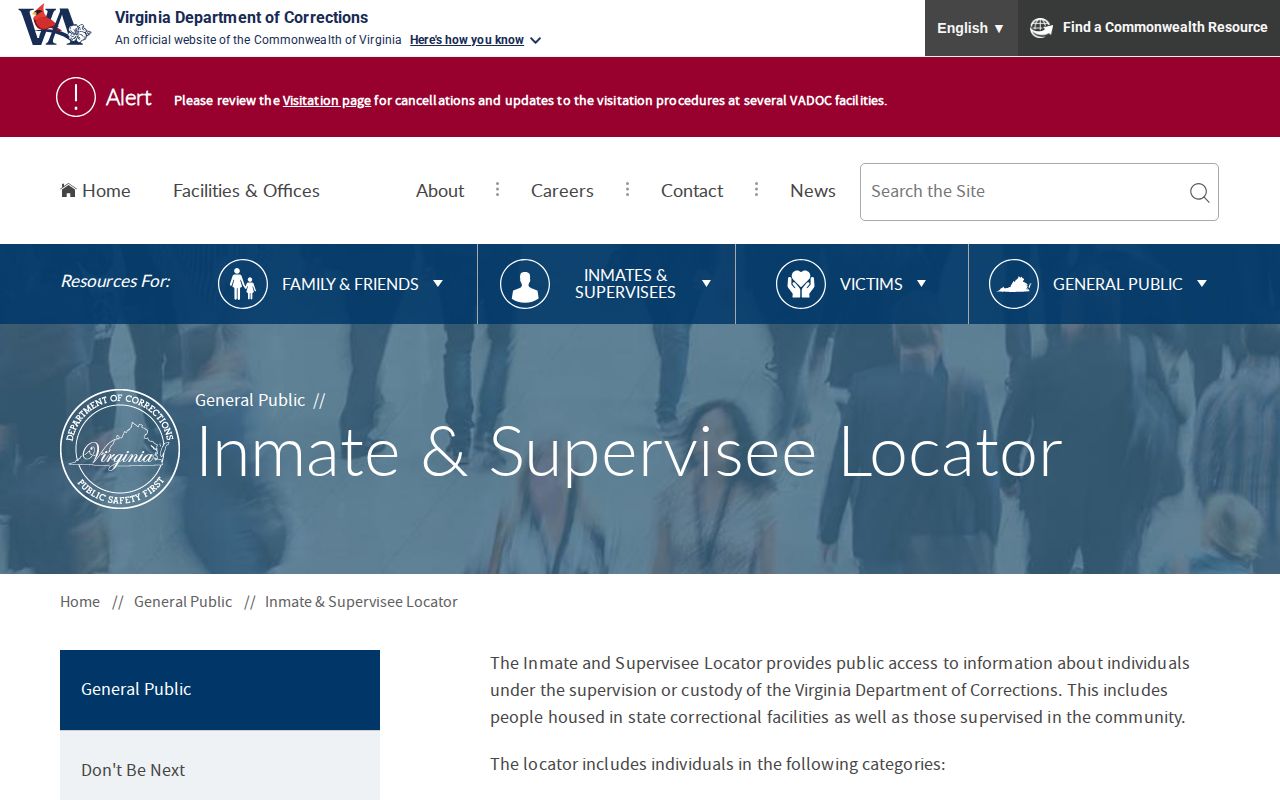
The captured page is a search entry, not proof of any individual's release, and each result still requires identifier and status review.
Virginia Corrections Release Documents
The most authoritative VADOC evidence includes an Order of Release and, when applicable, Conditions of Probation or Conditions of Parole. Operating Procedure 050.3 describes identity review against corrections records, witnessed signatures, an institutional gate pass, and checks for warrants, detainers, court orders, and uncalculated sentences before departure. These steps create a stronger trail than a changing locator screen.
The VADOC facility-release information also addresses property, funds, clothing, medication, release documents, and transportation. A property envelope may contain identity and education documents. Release staff and the departing person sign applicable papers. A planned pickup or transport arrangement does not prove that every hold cleared, so the final signed record and actual status remain important.
- Order of Release
- Identifies the authority for the state custody exit.
- Conditions document
- Shows probation or parole duties that continue after prison.
- Gate pass
- Connects the completed process to the institution and departure.
- Release date
- Must be read as completed or future, not assumed from the label alone.
Note: Signed release papers establish the completed event more firmly than a date copied from a changing public result.
Request Virginia Corrections Release Records
A former state prisoner's public locator entry may disappear after both custody and supervision end. That absence does not establish the date or type of discharge. Request the existing final release or discharge record, notification letter, Order of Release, actual release date and type, and releasing institution. Identify the full name, seven-digit DOC ID when known, facility, and approximate date. Ask for a photograph separately if one is needed, because it is a different record.
VADOC FOIA Contact
Anne-Cabrié Forsythe
P.O. Box 26963
Richmond, VA 23261
804-963-2953
FOIA@vadoc.virginia.gov
A request may also go to the unit manager, warden, superintendent, or district chief that maintains the record. VADOC identifies possible exemptions for inmate, supervision, health, criminal-history, investigation, and security records, so not every item is guaranteed. Ask for segregable nonexempt portions, electronic delivery, and an estimate before charges exceed a stated limit.
Virginia FOIA generally requires a response within five working days. Seven added working days may be invoked when production is impracticable. The agency can produce records, withhold with a statutory citation, produce portions, refer the request when another custodian is known, or report that the requested record does not exist. It need not create a new explanation.
Virginia Corrections Release Date Limits
VADOC's public term is “release date.” When the displayed date is in the future, it is a computation snapshot, not a promise. VADOC calculates qualifying state-responsible sentences over twelve months, while local authorities calculate other local sentences. A Bedford sentencing order starts the analysis but does not replace the responsible correctional authority's calculation.
Virginia uses Good Conduct Allowance for specified older offense categories and Earned Sentence Credit for many later felony sentences. Depending on offense, date, and classification, current credit may range from zero to 4.5 days per thirty days served for limited ESC-1 cases, while eligible ESC-2 rates can reach fifteen days per thirty. The familiar “85 percent” phrase is shorthand for one restricted framework, not a universal rule.
Prior jail credit, active term, consecutive or concurrent sentences, earning level, discipline, detainers, amended orders, and corrections can all move a date. A future parole decision or expected date also does not prove actual release. VADOC may discharge within a thirty-day period before ordinary expiration for uniform prerelease programming, and its public release page promises only release by 11:59 p.m. on the date, weather permitting.
Note: Use the agency's actual computation and final release record rather than subtracting a fixed percentage from a Bedford sentence.
Virginia Corrections Release Supervision
District 20 serves Bedford County and the City of Bedford. A person displayed at that office can be living in the community while still under VADOC supervision. That result supports release from prison, but it does not mean all obligations are complete. The official directory gives no universal first-report day, walk-in practice, or check-in schedule. The signed conditions and officer instructions control.
Virginia generally abolished discretionary parole for most felony offenses committed on or after January 1, 1995, but statutory exceptions remain. Older commitments, specified juvenile-related circumstances, geriatric conditional release, and other provisions prevent a one-rule answer. The Virginia Parole Board makes parole decisions, while VADOC administers community supervision. A grant still requires certification and release planning before the gate event.
The local verification steps and distinction between the two forms of supervision are covered under Probation & Parole. Completion of supervision can remove a person from the locator's stated population, so a final discharge document may be needed for an older event.
Regional Jail to Virginia Corrections
BRRJA's regional-jail model arose from a 1994 multi-jurisdiction response to outdated and overcrowded local jails. That is BRRJA history, not VADOC history. Its relevance here is limited but important: Bedford's local custody record is held in a regional system before a state-responsible prisoner is received into the separate Virginia corrections system.
The handoff creates two records. BRRJA documents the end of the BADC or other regional jail episode and the transfer destination. VADOC documents reception, institution placement, sentence computation, and eventual prison release or discharge. The Bedford County Sheriff is not the custodian of either complete chain merely because the underlying case began with a county arrest.
Compare the final BRRJA transfer date with the VADOC reception or locator record. A clean sequence shows continued confinement under a new authority. If the dates or identifiers conflict, ask the record owners to correct or explain their own entries. Do not merge the two systems into one “Bedford jail” record.
Virginia Corrections Release Notifications
VADOC stopped participating in VINE on October 1, 2021. Virginia Jail VINE remains the open notification system for local and regional jails, including the BRRJA category, but it should not be presented as the current state-prison alert platform. The public status route for a state prisoner is the VADOC locator.
VADOC's separate NAAVI program is available through Victim Services for qualifying victims. It is not an open public lookup. Victim Services distinguishes anticipated release, generally communicated about thirty days ahead, from actual release when the person is no longer in VADOC custody. It also addresses transfer and other eligible changes. The distinction between an alert and the final custody record remains essential.
A local-jail VINE event may report that a Bedford detainee left BRRJA for VADOC. That event confirms a change reported by the jail, not a state-prison release. Follow the person into the receiving system and use its status, dates, and release documents.
Bedford Virginia Corrections Record Chain
No VADOC prison was identified as physically located in Bedford County. A Bedford conviction therefore does not imply that imprisonment occurred in Bedford. Classification can place the person elsewhere in Virginia. The statewide locator and VADOC records, rather than the BADC current roster, control the state portion of the search.
The strongest completed chain uses the Bedford court sentence, BRRJA transfer record, VADOC reception and institution result, final Order of Release or discharge response, and any District 20 supervision assignment. Each document answers a defined question. A current BADC roster is for local jail custody. A state institution result is for prison custody. A district result reflects supervision, and a final discharge record proves the later endpoint.
The full Bedford County release and records search provides the fallback when federal custody, ICE, another jail, or court sealing changes the expected route. A “not found” result should never be converted into release without checking the correct system and a second official source.
Note: State prison release proof comes from VADOC and the court record, not from a Bedford County current-jail screen.