
Bedford Projected and Actual Release
A projected release date is a computation snapshot. It combines the active sentence with credit rules and facts known to the responsible authority at that time. The actual release date records when custody ended. A future date, parole agenda, or court expectation is not proof that a person walked out. Release can be delayed, recalculated, or converted into a transfer to another custodian.
The legal stage matters. A person held before trial may leave after bond, recognizance, dismissal, or another court order. Since no sentence calculation controls that stay, there may be no set date to look up. A sentenced local inmate may have a date calculated by the regional jail or local authority. VADOC calculates qualifying state-responsible sentences. The Bedford court order starts the analysis, but it does not include all credit, discipline, or detainer information.
Find Bedford Projected Release Dates
First identify the custodian. Use the BADC current locator only to see whether a person appears in BRRJA custody. That locator is not a verified historical release archive, and an absent result may mean transfer, a failed match, or release. For a state sentence or VADOC-supervised case, use the official Inmate and Supervisee Locator. For a local sentence, ask BRRJA for the existing computation or final release entry and compare the Bedford court order.
Use a seven-digit DOC ID when available. A name search needs at least the first three letters of the first name and the full last name. Filters can help with common names. VADOC says the data update daily but can be inaccurate or outdated. Record the date accessed and preserve the exact label shown. If the public result has no date, do not infer one from sentence length.
- Match the full name to a DOC ID, booking number, or court case number so the date belongs to the right person and episode.
- Determine whether Bedford regional-jail custody, VADOC custody, community supervision, federal custody, or another hold controls the person.
- Read the official date label as displayed. Treat a future release date as subject to change.
- Compare the sentencing order, jail credit, active sentence, and any later amended or revocation order.
- Ask the computing authority for clarification or an existing sentence-status record when the web result and court file do not agree.
- After the expected day, confirm the actual event through the final release record or the receiving custodian.
For a broader named-person search across Bedford's custody systems, use the Bedford County released-inmate lookup.
Bedford VADOC Release-Date Fields
VADOC calls its public tool an Inmate and Supervisee Locator. It covers people in institutions, people under probation or parole supervision, some local or regional jail placements under state authority, institutional-hospital placements, and CCAP participants. It does not cover every person ever held at Bedford Adult Detention Center. A named prison means confinement. A probation and parole district can show a transition to community supervision.
The public locator describes a “release date,” so that is the label to quote. When it lies in the future, describe it as prospective. Operating Procedure 050.6 says sentence-status information may include projected parole eligibility, mandatory parole, or good-time release dates at the time of inquiry, but not every public result will show each field.
| Locator item | How to read it |
|---|---|
| DOC ID | Seven-digit identifier used to reduce name confusion |
| Institution location | The person remains in VADOC custody at a prison or covered placement |
| District-office location | Community supervision may have begun; this is not full discharge |
| Future release date | A prospective computation, not proof of release |
| Past or completed date | Potential retrospective evidence that must still match the correct record |
| No result | Not proof of release; a direct record request or court check may be needed |
The VADOC locator page appears below as captured for Bedford release-date research.
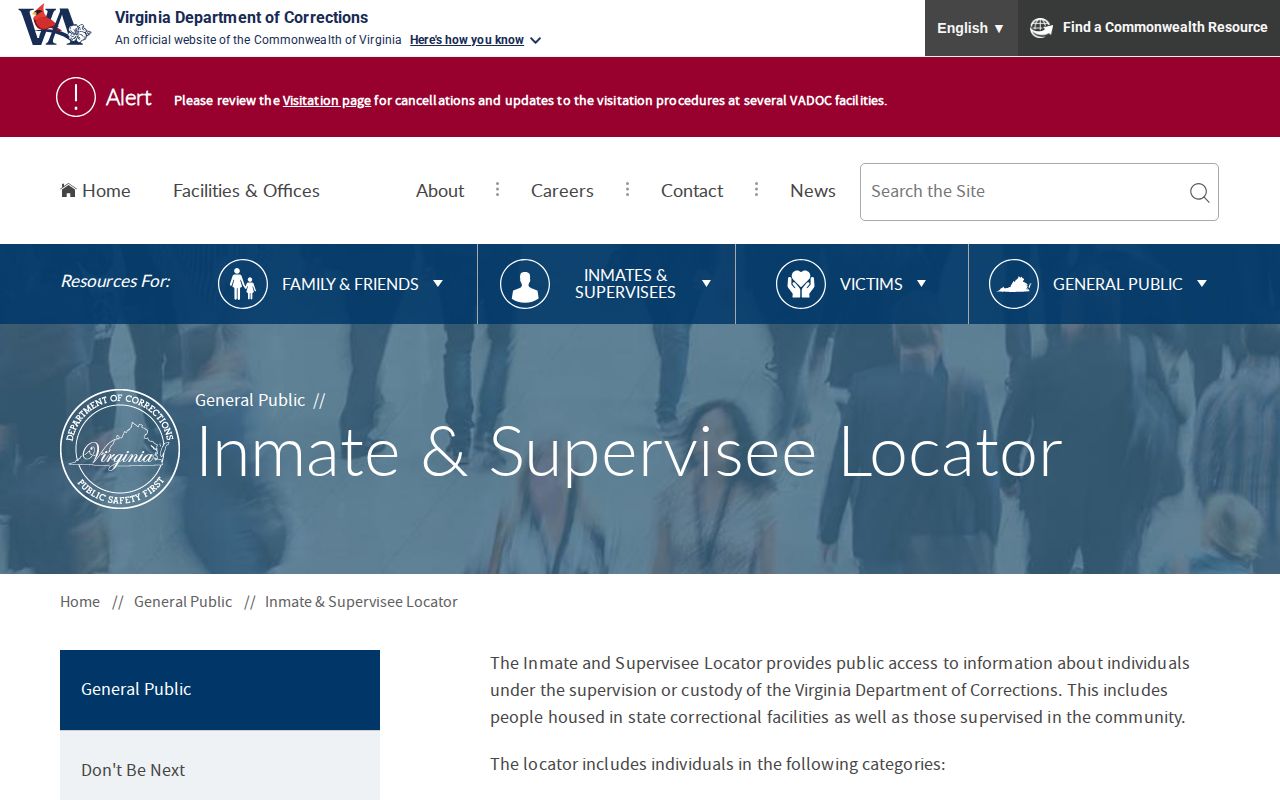
Its search form helps identify the record, but the current result and source documents determine what any displayed date means.
Bedford Sentence Credit Systems
Virginia uses more than one credit framework. Good Conduct Allowance, or GCA, generally relates to felony offenses committed before January 1, 1995 and misdemeanors committed before July 1, 2008. VADOC says GCA can range from zero to 30 days per 30 served, depending on class. Earned Sentence Credit, or ESC, generally applies to felony offenses committed on or after January 1, 1995. The offense, date, and classification determine which rule applies.
Under Virginia Code § 53.1-202.3, restricted ESC-1 categories can earn up to 4.5 days per 30 days served. Eligible ESC-2 levels can range from zero to 15 days per 30, with intermediate rates. That is why the common “at least 85 percent” statement is shorthand, not a universal formula. In a simplified maximum 4.5-per-30 example, the term served is about 86.96 percent.
The official VADOC Time Computation page explains the GCA and ESC systems shown in the captured image.
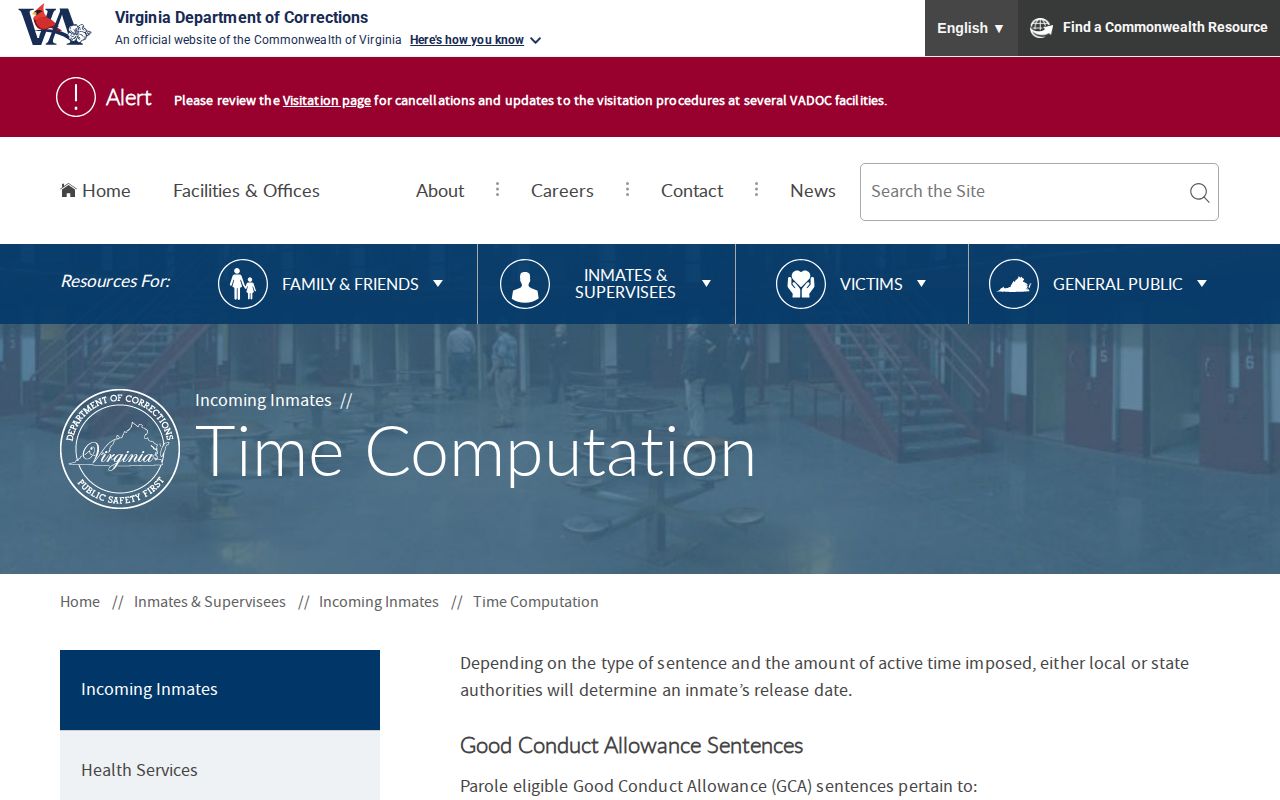
The page confirms that credit class, sentence type, and responsible authority matter more than a quick percentage calculation.
Note: The court's active sentence is essential, but the authority's credit computation supplies the prospective release date.
Why Bedford Release Math Varies
Virginia's date is not the sentence minus one fixed percentage. Prior jail credit can reduce time left after reception. Consecutive sentences run one after another, while concurrent sentences overlap as the governing orders permit. Earning levels can change with conduct. Certain offenses have limited credit rates. A revocation, amended order, correction, or uncalculated sentence can also alter the computed result.
Responsibility is split as well. VADOC calculates qualifying state sentences over 12 months, while local authorities calculate other local sentences. A Bedford County defendant can therefore have a court order, a BRRJA calculation, and later a VADOC calculation at different points in the same custody chain. Ask the agency that currently owns the sentence computation. Do not subtract credits without knowing the offense date, class, jail credit, and sentence structure.
Another Virginia rule affects the release window without changing credit math. Under Code § 53.1-28, VADOC may discharge a person during the 30-day period before ordinary expiration to support a uniform prerelease program. The agency's public release information promises departure by 11:59 p.m. on the date, weather permitting, not a standard morning gate time. Transportation planning and a final detainer check remain separate parts of release.
Bedford Release Dates Can Change
A change does not automatically mean the first record was false. It may reflect new facts or a later legal action. Compare the access dates and document type before deciding which entry controls. A live computation should be confirmed again near the expected release day.
| Factor | Possible effect | Record to check |
|---|---|---|
| Jail credit | Reduces remaining time when properly applied | Sentencing order and computation record |
| Credit earning level | Speeds or slows the prospective date | VADOC or local sentence-status record |
| Discipline | May reduce or change earned credit | Official computation and disciplinary record if releasable |
| Consecutive sentence | Adds active time after another term | Court orders and sentence summary |
| Amended or revocation order | Changes the active term | Bedford court file |
| Warrant or detainer | May cause a handoff instead of community release | Release review and receiving-agency record |
| Parole action | May create a conditional release path for an eligible case | Board decision and certified release papers |
Note: Compare computation records by access date because a later credit, order, or hold can lawfully move the projected release date.
Bedford Local Release-Date Authority
Bedford Adult Detention Center is operated by the Blue Ridge Regional Jail Authority. BRRJA, not the Bedford County Sheriff, is the likely custodian of BADC admission, movement, local sentence, and final release or transfer entries. The Sheriff can hold separate arrest or incident records, but those do not replace the jail computation. A request sent to the wrong office may produce a referral without answering the date question.
For a local sentence, give BRRJA the full name, booking number or date of birth if lawfully known, BADC, the approximate booking range, and the precise existing record sought. Ask for the sentence-status computation or final release/transfer date and type. The BRRJA FOIA page lists the authority's request path. Under Virginia Code § 2.2-3704, the agency may produce, partly produce, withhold with a cited basis, refer, or invoke lawful extra time. It need not create a new calculation for a requester.
A court release order and a physical jail exit can occur at different times. BRRJA still must complete identity, record, property, and hold checks. If the person leaves BADC for another BRRJA facility or VADOC, the BADC episode ends but government custody does not. Ask for the destination category whenever the date alone would leave that issue unclear.
Confirm Bedford Actual Release
After the projected day, look for the final release order, release letter, or booking disposition. Jail VINE can report a BADC custody event, but it cannot by itself distinguish community freedom from transfer to VADOC, another jail, ICE, or a warrant-holding agency. Virginia's systems also split by custodian: local and regional jails use Jail VINE, while VADOC stopped participating in VINE in 2021. State-prison public status belongs in the VADOC locator, and qualifying victim notification uses NAAVI through VADOC Victim Services.
The Bedford VINELink inmate search explains how to register for a local-jail event and interpret the reporting agency. For VADOC, preserve the Order of Release and any Conditions of Probation or Parole. Those papers, along with a district assignment, show what followed prison custody. A detainer can turn the expected date into a transfer rather than a return to the community.
VADOC's final process also checks identity against its records, reviews warrants, detainers, court orders, and any sentence not yet calculated, and produces an institutional gate pass. Release planning can address the approved address, transport, property, funds, clothing, and medication. Those checkpoints explain why the date field alone cannot describe the full event. The signed order and receiving-agency record establish more than a forecast.
For durable proof, request the final release date, release authority or type, releasing facility, and destination category from the record owner.
Note: A release alert confirms a reported custody change; the receiving system determines whether government custody continued elsewhere.