
Bedford Federal Release Paths
No federal correctional facility was identified in Bedford County. The federal route matters only when the case or custody record is federal. A sentenced prisoner may be held at a BOP institution elsewhere, then leave BOP custody at the end of the federal term or under another lawful release process. The person may still face federal supervised release, another jurisdiction's custody, or another legal obligation.
A federal pretrial detainee follows a different chain. The U.S. Marshals Service manages and transports federal pretrial prisoners and may use contract beds. That person may not have a BOP historical record yet. “Not in BOP Custody” therefore does not prove community release. It can include a person never received by BOP or held by another justice agency.
| Case path | Primary source | Meaning of departure |
|---|---|---|
| Sentenced federal prisoner | BOP Inmate Locator and federal court | BOP custody ended; another status may follow |
| Federal pretrial prisoner | Federal docket and limited USMS inquiry | Court or USMS action controls |
| BADC detainee | BRRJA record | Local or regional jail episode, not automatically federal |
| Virginia state prisoner | VADOC record | State custody, outside the BOP locator |
| ICE detainee | ICE ODLS and ERO | Civil immigration custody, not BOP custody |
Confirm Bedford Federal Release
Search the official BOP Inmate Locator by BOP, DCDC, FBI, or INS number when known. A name search also allows optional demographic filters. Record the register number, location, date label, and date accessed. BOP covers federal inmates from 1982 forward, so it is not a complete source for earlier imprisonment or for every federal pretrial placement.
Read the full result. A past release date with no facility can be historical evidence that BOP custody ended on that date. A future release date is projected. “UNKNOWN” means the term is not determined. The date column can also report death. BOP says its information updates daily and warns that First Step Act recalculations can temporarily make dates stale.
- Confirm that the case is federal before using the BOP system.
- Search by the strongest register or agency number, then verify the full identity.
- Read the location and release-date fields together rather than relying on one label.
- Compare the result with the federal court docket and sentencing or release order.
- For a pretrial case, use the court and limited USMS route rather than assuming BOP coverage.
- Check the receiving system if the result shows BOP custody ended but another hold is plausible.
A Bedford case may also have a separate local episode. The Bedford County release search distinguishes BRRJA, VADOC, federal, and ICE records.
Federal Release Locator Fields
BOP results can include name, register number, age, race, sex, release date, and location. Those fields help identify the right federal record, but they do not explain every later legal status. A label such as “Released” or “Not in BOP Custody” means BOP is no longer the holding agency. BOP itself warns that the person may be in another justice system, law-enforcement custody, parole, or supervised release.
The official federal locator appears in the Bedford research capture below.
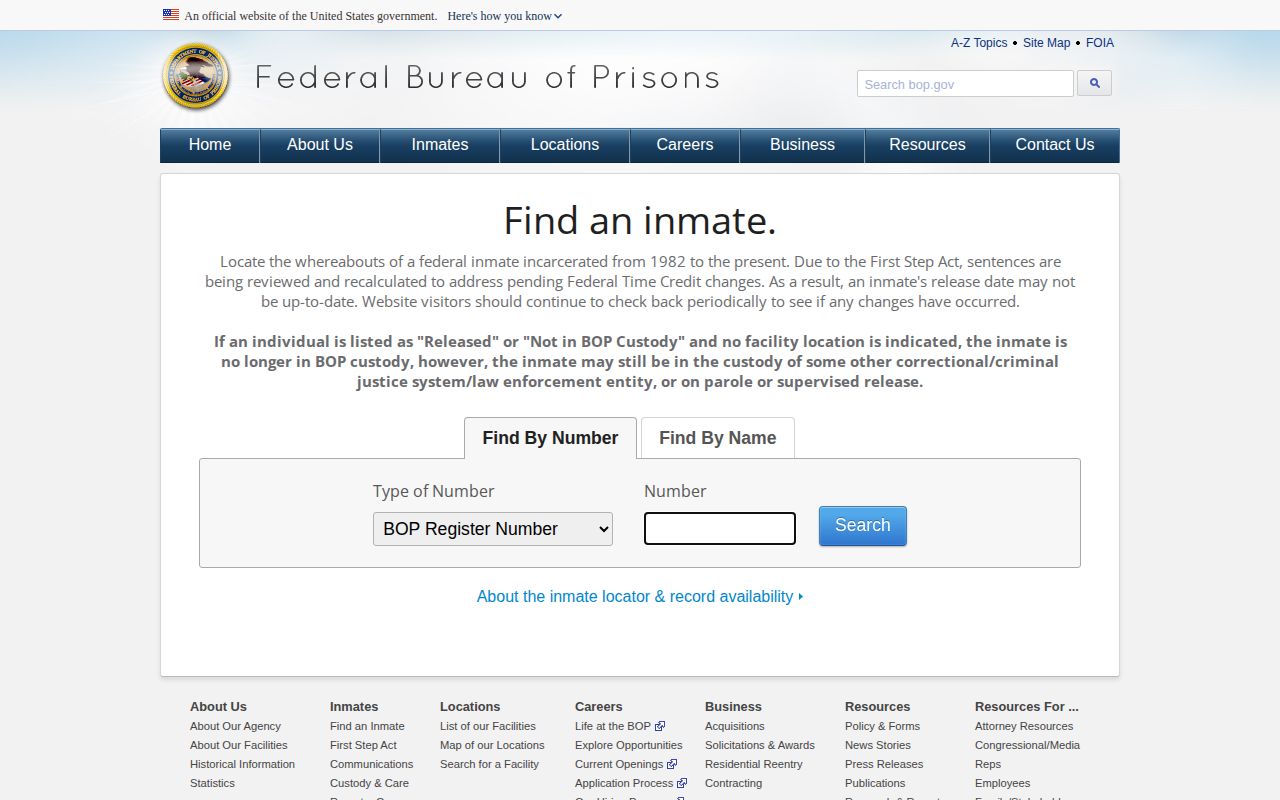
The search form is the entry point. A matched result and federal court record supply the event-specific evidence.
- Register number
- The federal identifier used to reduce name confusion.
- Released
- BOP custody ended, without a promise that all legal control ended.
- Not in BOP Custody
- The person is not held by BOP and may be elsewhere.
- Future date
- A projected date subject to change.
- UNKNOWN
- The release term is not determined in the displayed record.
Federal Release Search Contact
Because no BOP institution was identified in Bedford County, there is no local federal facility contact to list. Use the national BOP locator for sentenced federal records and the federal court docket for the legal action. A facility contact, when a result names one, should be taken from BOP's current official directory rather than inferred from the Bedford arrest location.
Federal Bureau of Prisons Inmate Locator
Official online federal inmate search
Covers BOP records from 1982 forward
Search by federal identifier or name
For a limited current-custody question involving a federal pretrial prisoner, USMS may verify present custody but generally does not disclose personal location, schedule, or transport detail. It has no public historical person locator comparable to BOP. Use the federal docket for durable case events.
Note: A Bedford arrest location does not establish which BOP institution, contract bed, or federal custodian later held the person.
Bedford Federal Pretrial Custody
USMS pretrial custody must not be forced into the sentenced-prisoner search. A person can be housed under contract, moved for court, or held by another agency without a settled BOP record. The federal court docket can show detention, bond, plea, sentencing, and later orders. It may not show the minute a transport or physical exit occurred.
Match the federal case number, defendant identity, hearing date, and order. If the person later enters BOP custody after sentencing, the BOP register number creates a stronger bridge to the locator. If the court orders release but another warrant or detainer applies, the USMS episode may end through a handoff rather than community return.
Bedford Regional Federal Boundary
Bedford's adult regional-jail model dates to a 1994 multi-jurisdiction response to aging, crowded local jails. That history explains why BRRJA, not the Sheriff, keeps BADC booking and movement records. It does not make BRRJA a federal agency or BADC a federal prison. A federal detainer or USMS placement must be supported by the individual record.
If a BADC booking ends with delivery to a federal custodian, the BRRJA records route can confirm the local episode and destination category. The federal court, USMS, and later BOP record address what happened next. Search both sides of the handoff. Never treat disappearance from the BADC locator as proof of federal transfer, and never use a BOP result to rewrite the earlier BRRJA record.
Federal Release Date Limits
A BOP future date is a forecast. First Step Act recalculations, sentence changes, and other official updates can affect it. A federal sentencing date also does not prove when custody began or how credits were applied. Use the exact BOP label and avoid doing independent sentence arithmetic.
For a completed event, look for a past date, no active facility, and a court or BOP record that matches the register number. Even then, “Released” speaks to BOP custody. Federal supervised release, another warrant, state custody, or ICE action may follow. The destination and controlling order answer whether the person returned to the community.
Virginia Jail VINE does not cover BOP custody. It can report an event from a participating local or regional jail, but that event must not be extended to a later federal sentence. Federal notification and custody information must come from the federal source.
Note: A future BOP date can change, while a past matched date addresses only the federal custody episode shown.
Bedford Federal Release Proof
The strongest public chain uses a federal identifier, matched BOP result, and the relevant federal court order. If BRRJA held the person first, add the final BADC transfer or release entry. If another agency took custody, use that agency's positive record. Each document should describe its own segment rather than being treated as a universal history.
Do not use a federal booking photograph as release evidence. The BOP locator is a custody-and-date tool, and USMS generally does not release prisoner booking photos. News or unofficial listings can lead to a case number, but they cannot replace the federal docket or BOP record.
The federal release record route is specific to federal custody. Ordinary Bedford jail or Virginia state-prison cases belong in their respective systems.
Note: A past BOP date proves the end of the matched BOP episode, not the end of every possible custodial or supervision status.
Bedford Federal Court Cross-Check
The federal docket supplies the legal sequence around detention, plea, sentence, bond, appeal, and release-related orders. It is especially important when the person was managed by USMS before BOP reception. A docket entry can explain why custody changed, while the custodian's record establishes where the person physically went.
Begin with the federal case number. Match the defendant's full name and any register number that later appears in BOP. Read the order date and effective terms. A sentencing entry does not calculate credits by itself, and a release order may still be followed by another jurisdiction's hold.
For older proof, preserve the docket entry and the BOP result together. If they conflict, compare update dates and ask the federal record owner about its own field. Do not choose the source that merely gives the preferred answer. A signed order and a matched federal custody record have different but complementary roles.